Average Reviews:

(More customer reviews)This is one incredible camera. Here are some of the best features about it:
-3CCDs
-L Series Fluorite Lens
-All Manual Controls
-Progressive Scan
-Optical Stabilization
-Large Manual Focus Ring
Of course, we all know that 3CCDs are far better than one... I need not go into more depth there. As far as the lens goes, some have argued that they see no difference of quality over that of Sony's. This may be due in part to the fact that they are looking for a difference in resolution. When compared in numbers to some of the 3CCD models of Sony, you may think that this is a lower resolution camera (which can be a very deceiving thing). It is recognized that a camera with a high resolution in numbers does not equal a pleasing, or sharper image. When you compare the color of a Sony and this GL1 (or any other Canon against a Sony, for that matter), there will be no comparison. The Sony will inevitably lean towards the blues, giving a very cold, unnatural feeling, which can often result in having to waste time in post, by adding color corrections. The Canon will have a much warmer, more natural coloring. With deeper, richer blacks.
The Progressive Scan (or frame mode) is beautiful. It gives the footage a much more film like jitteriness, instead of the liquid smooth interlaced footage that is usually the only option you have on most Sony camera models. It is called "frame mode" because it captures 30 FULL frames per second, instead of 60 FIELDS per second (top field and bottom field) being joined together to make the 30 frames, which when slowed down will show interlaced lines. Some say ...that Progressive Scan is only meant for a "digital motor drive" where you capture 30 frames per second with the intent of getting still pictures from it. Yes, this is a possibility... but no, video is not really high resolution enough to use this for any real purpose other than having a somewhat grainy image for a home web site. I have not heard of ANY professional using it for anything other than to shoot a real project, as true video footage. Video to film transfer locations prefer people to use progressive scan to shoot on their GL1 or XL1 for film transfer. It loses much less quality in the process. There are many commercials and documentaries (as well as independent films) which have started shooting in progressive scan on the GL1 and XL1, in order to get the higher budget film look.
The manual controls on this camera give you such control, that you can achieve truly professional results. You have control over - Shutter Speed, Aperture, Gain, White Balance, Focus, exposure, etc. If you want the choppy effect of Saving Private Ryan, or Gladiator's battle scenes, just up the shutter speed to 250 or higher. Or if you want a lot of background blur, open the lens way up.
Ah, yes... the image stabilization. You won't get anything close to it on other brands. They all have a slight shake, and jitter, never truly stabilizing it, especially when zoomed. This one has none. It only floats. And of course, if you want that jittery handheld look of some of the new films and such, just turn it off. But when you want smooth, non jittery handheld shots it's always there.
If you are trying to decide what camera to get, always go down the Canon road. Almost all of them have features that Sony only tries to make up for with home userish built effects and such cheesy non-professional effects that one can achieve if they have a computer to edit on (and still want the effects by then. Why record it permanently, when you might change your mind later). Some Sony users complain about how Canon does not have good still picture resolution. I say, "who needs still pictures on a camcorder??" That should be left to 35mm, or a digital camera devoted to that form of media alone. I have yet to see a printable, good looking still even from a Sony. Both the video format, and the small included memory cards cannot handle the resolution required of this. With all the manual controls, the far superior color, and the incredible look of progressive scan, one must have only the choice to go Canon. If you are an aspiring documentary or commercial maker trying to decide between a GL1 and an XL1 (not likely), the advantage of the GL1 (besides the price) is that it is small. This allows you to be in crowds shooting, without stares from everybody. Or shoot where you would otherwise be unable. This can also be a downfall. It may look wimpy to the client (of course, once they see the footage, they will probably buy one themselves). ....
Lastly, I just want to say that I would highly recommend this camera, but if you can afford it, go with the XL1 (...), it is even better!
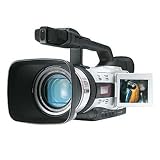
Click Here to see more reviews about: Canon GL1 MiniDV Digital Camcorder with Lens and Optical Image Stabilization
Product Description:
The Canon GL1 (and its big brother, the XL1) are helping to blur the line between consumer and professional video equipment. This camcorder borrows most of the professional-quality components from the XL1 and puts them into a more compact, affordable camera. Though it's small enough to carry around and doesn't cost much more than a top-of-the-line consumer camcorder, the GL1 produces such high-quality results that it could be used as a broadcast videocamera.
Great movies start with great CCD sensors, and Canon cuts no corners here. For the best possible picture quality, they use three separate 270,000-pixel CCDs (one for each primary color). To further improve image detail, Canon has intentionally shifted the green CCD half a pixel horizontally and vertically. This shift allows more accurate interpolation, resulting in an image that Canon claims rivals those from cameras with 410,000-pixel CCDs. Each pixel is 72 square microns, which is about 1.5 times the size as those in competingcamcorders. This increased size increases light sensitivity, allowing you to shoot in lower-light situations. Ultimately, the larger pixel size results in an improvement of 4 dB loss budget in sensitivity.
For great optical quality, the GL1 uses a fixed (nonremovable) 20x optical (100x digital) zoom L-series fluorite lens. The fluorite element in the lens increases sharpness and contrast, as well as helping to preserve color fidelity.
Audio is recorded through the built-in microphone, which features two pairs of pickup elements. Audio can be recorded in 16-bit mode on two channels on one track. Alternatively, audio can be record in 12-bit mode, where the audio track is divided into two, and two channels of audio are recorded onto one track, with the other left over for audio dubbing.
The electronics of the GL1 have many advanced features, including a number of programmed AE modes, as well as both shutter and aperture priority modes. There are two different auto modes, one of which allows you to adjust any setting manually, if you want, and the other, which adjusts every setting automatically and lets you adjust nothing. A spotlight mode automatically compensates for lighting difficulties when shooting a subject bathed in a spotlight. Finally, a sand-and-snow mode is designed to prevent dark, underexposed subjects in situations with bright backgrounds--commonly found in sandy and snowy areas. There are also three different shooting modes: normal movie mode, digital photo mode, and frame movie mode. Normal movie mode is for any time you want to shoot video footage. Digital photo mode records a still image for six seconds on the miniDV tape, and also captures any audio, such as a commentary. The frame moviemode records 30 still images per second, but it isn't intended to be used for shooting video. Rather, frame movie mode should be used as burst or continuous shooting mode, as you'd find on a still camera.
The GL1 uses an IEEE 1394 port for digital editing and for transferring footage to and from other IEEE 1394-compliant devices. The camcorder also has RCA (composite) audio and video ports, and an S-Video out. The analog inputs allow you to transfer old footage to DV for archiving. Built-in effects include a fader for transitions, black and white, slim, stretch, and strobe. Picture adjustment is also possible; you can adjust camera sharpness, softening orsharpening your subject, as well as the color tone and how dark or light the camera sets the auto-exposure level.

Want to buy Canon GL1 MiniDV Digital Camcorder with Lens and Optical Image Stabilization at other amazon sites? Click the corresponding icon below:


0 comments:
Post a Comment