Average Reviews:

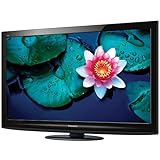
(More customer reviews)If you are like me, you put a lot of research into a expensive purchase like a flat screen television, especially since it is something you plan to use for several years.I chose the Panasonic G25 after months of research trying to determine which was "better", LCD or Plasma, while also investigating which brands and models were the best performers.
What's in the box?
*The50" TV
*Swivelstand
*Lighted remote, including batteries
*Detailed Instruction manual
*Quick Start Guide
I purchased this TV as our main television in our family room.I own two other flat screens, both LCD and both from Panasonic, 32" and 42".
Set up is a breeze.The box is designed to be easily opened by releasing four plastic clips built onto the box.This allows the top (most of the box) to be lifted of the TV, while the TV remains secure and stationary in the lower part of the box.The included swivel stand comes in two pieces and is easily assembled with a few included screws. If you use this stand, you simply have to lower the TV onto the stand.This can be done vertically without laying the screen down on its face, since the design of the TV mounting components are flush with the stand. Some TVs require you to place the TV in a horizontal position to mount it to their stand.You possibly could do this assembly alone,as the TV is not very heavy, but due to sheer size, it is extremely prudent to have someone help you.
Many professional reviews will advise you to beware of plasma "burn in" of images, or using plasma in a brightly lit room.I worried about these two things constantly during my research.
Panasonic's manual does advise you not to leave a4:3 image, or any still image on the screen on the screen for very long periods as it can contribute to some burn in.But in general, even if you watch 4:3 mode all day long, the TV has a couple of features which helps protect its image, including orbiting pixel technology and a scrolling bar which can be run across the screen to help cleanse it.I have watched a good deal of 4:3 format on this TV and have not had any issues whatsoever.The orbiting technology slightly moves pixels about, undetectable to the human eye, which really minimizes the chance of any burn in.
As far as a bright room, don't worry!My family room is decent size, and has a cathedral ceiling with a skylight, plus a southern wall that is almost all window and a sliding door on the opposite wall.So the room has lots of light.I can watch the TV during the brightest time of day without any loss of quality or viewing ability.The anti-glare feature of the screen reduces the natural reflective characteristics of glass down to practically nil.
I tend to watch most programming on the TV's THX mode.This will give you a somewhat less bright display than the G25's "Standard" or "Vivid" mode or compared to most LCDs, but personally I am looking for the most accurate, pleasing display, not simply "the brightest".If you do prefer a very bright display, the TV's numerous picture settings can easily give you a bright display.
I am a huge Panasonic fan, and that did factor into my choice of TV.I find Panasonic typically gives you high quality at a reasonable price.
As for price, you will spend several hundreds of dollars more for an LCD of comparable size and quality.Some better quality LCDs in this size range will cost double what the G25 sells for.
Most of the features on the TV and remote are intuitive and the menu offers general explanations of the purpose of each setting.The remote itself is well laid out and easy to navigate, although this was not very important to me since I am using my FIOS remote for most typical functions.
There are three HDMI ports on the TV, as well as RCA and component connections and coax input.There is also a PC port as well as two USB ports. The lone port type absent is S-Video.While S-Video is pass

0 comments:
Post a Comment